

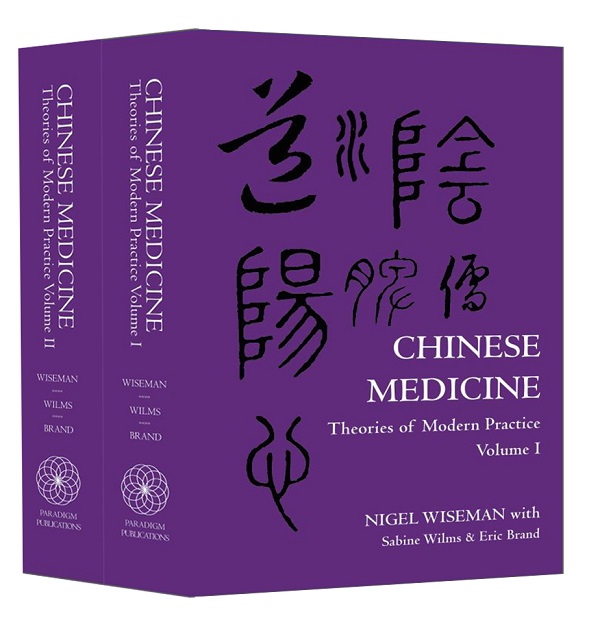


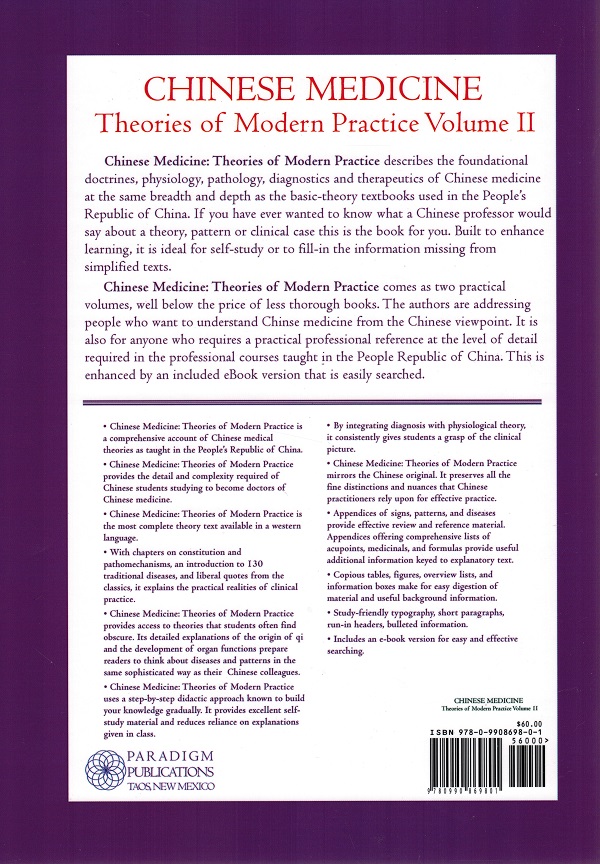
Description
By Nigel Wiseman with Sabine Wilms
Trade Paperback 2 Volumes
Set ISBN 978-0-9908698-7-0
Volume 1; 978-0-912111-83-4, 564 pages
Volume 2; 978-0-9908698-0-1, 732 pages
The Most Complete English-Language Presentation of Chinese Medical Theory
Chinese Medicine: Theories of Modern Practice presents the foundational doctrines, physiology, pathology, diagnostics, and therapeutics of Chinese medicine at a level approaching the basic-theory textbooks used in Chinese medical universities. Designed for serious students and practitioners, it provides English-speaking readers with access to the conceptual framework of Chinese medicine as it is studied and taught in China.
Chinese Medicine: Theories of Modern Practice is written for readers who wish to understand Chinese medicine from the Chinese perspective. Rather than simplifying complex ideas, the text preserves the distinctions and terminology found in Chinese-language sources, allowing students to study the discipline with the same conceptual clarity available to their Chinese counterparts. Issued as two convenient volumes, it provides an authoritative reference at a remarkably accessible price. For Redwing Books direct retail customers, an accompanying eBook version adds powerful searchability and ease of use.
This text adopts modern pedagogical features designed to support systematic learning and long-term retention.
- A clear, step-by-step presentation of information takes the student from fundamental concepts to clinical understanding. Concepts are carefully explained at their first appearance and reinforced throughout the text.
- A holistic structure links physiology, pathology, diagnosis, and treatment. Chapters describing qi, blood, fluids, bowels, and viscera include previews of major signs, patterns, and diseases, while pattern identification chapters review the physiological and pathomechanistic foundations necessary for clinical understanding.
- Important information is presented in concise paragraphs and bullet points that highlight key concepts and make the material easier to review and memorize.
- Chinese characters and pinyin equivalents are provided for major concepts. This assists students studying Chinese and emphasizes the precise technical meanings underlying Chinese medical terminology.
- Extensive indexing provides powerful reference tools. Separate indexes for signs, patterns, diseases, acupoints, medicinals, and formulas connect theoretical concepts with the clinical realm.
- Cross-referencing throughout the text enables readers to move quickly between related discussions and deepen their understanding of complex topics.
- The book covers the full range of basic theory—from fundamental doctrines through pattern identification—with a breadth and depth comparable to Chinese-language textbooks.
- Printed as two practical volumes for convenient use in study and clinical reference.
- Information is organized using tables, summaries, and explanatory displays that clarify relationships between concepts.
- Appendices and indexes provide rapid access to clinical information for review and reference.
- For Redwing Books direct retail buyers, an accompanying eBook provides full-text searchability, a clickable table of contents, and cross-references for easier study and navigation.
- The digital edition includes full-text searchability, a clickable table of contents, and cross-references that allow readers to navigate the material with ease.
Basic theory textbooks in Chinese are far more detailed than most English-language introductions to Chinese medicine. Chinese Medicine: Theories of Modern Practice makes this level of detail accessible to English-speaking readers while avoiding the heavy reliance on classical quotations that often complicates Chinese textbooks.
Following principles of effective knowledge acquisition, the text is organized into focused paragraphs, summaries, and lists that allow readers to absorb complex material efficiently. Chinese characters and Pīnyīn are provided for key concepts not only to assist language learners but also to show how English terminology reflects the original Chinese ideas.
A vast amount of indexed material is included—far more than is typically available in either Chinese or English-language texts. The detailed indexes make the printed volumes powerful reference tools, while the accompanying eBook allows unlimited searching and rapid navigation through clickable cross-references and a comprehensive search function.
Overview and Fundamental Doctrines: The opening overview provides readers new to Chinese medicine with a clear orientation to the subject and prepares them to understand the conceptual structure of the discipline. The chapters on qì, yīn-yáng, and the five phases examine the core theoretical foundations of Chinese medicine in far greater detail than most English-language texts, explaining both the concepts themselves and their historical origins.
Bowels, Viscera, Substances, and Channels: Detailed discussions of the organ systems include physiological functions, associated patterns, and the relationships that link physiology with clinical presentation. The chapters on qì, blood, essence, and fluids explore the fundamental substances of Chinese medicine, explaining their physiological roles and pathological transformations in clinical disease. The channel system is likewise presented with a level of detail comparable to Chinese-language basic theory textbooks, connecting channel physiology with pathology and treatment.
Constitution, Causes of Disease, and Pathomechanisms: A full chapter examines several constitutional classification systems found in Chinese medical literature, an area rarely discussed in English-language texts. The discussion of etiological factors reflects the teachings of Chinese medical textbooks while relating specific causes to the patterns and diseases they produce. The chapter on pathomechanisms explains how illness develops and evolves over time, helping practitioners identify root causes and anticipate the progression of disease.
Diagnosis, Pattern Identification, and Treatment: The four examinations of inspection, listening and smelling, inquiry, and palpation are described with far greater nuance than in most English-language texts. Extensive chapters on pattern identification guide readers through the diagnostic frameworks used to interpret signs and symptoms and connect them to treatment strategies. The final chapter outlines the principles guiding acupuncture, medicinal therapy, and dietary therapy, along with general strategies for preventing illness.
Indexes: Unlike most Chinese or English texts, the book includes a remarkable amount of indexed material.
- Index 1: Signs lists more than 320 symptoms from head to foot.
- Index 2: Patterns summarizes the 119 disease patterns discussed in the book.
- Index 3: Diseases describes the 130 diseases referenced in the text.
- Index 4: Acupoints lists all channel and non-channel points (over 400 in total).
- Index 5: Medicinals lists over 400 commonly used medicinal substances.
- Index 6: Formulas lists more than 400 formulas with their ingredients and applications.
About the Authors:
Nigel Wiseman and Sabine Wilms are internationally respected scholars of Chinese medicine who have devoted decades to studying its language, history, and clinical literature. Nigel Wiseman is widely known for his pioneering work in Chinese medical terminology and translation. His publications include Fundamentals of Chinese Medicine, Fundamentals of Chinese Acupuncture, and the landmark reference work A Practical Dictionary of Chinese Medicine.
Through careful translation and rigorous scholarship, the authors have sought to preserve the precise meaning of Chinese medical concepts in English. Their approach allows readers to encounter Chinese medicine as it is understood within its own intellectual and cultural tradition. By faithfully reflecting the language and conceptual structure of Chinese medicine, Chinese Medicine: Theories of Modern Practice enables Western students and practitioners to develop a deeper and more accurate understanding of this sophisticated medical system.

Reviews
There are no reviews yet.