
Description
By Yitian Ni
Trade paperback book
ISBN 9780967303437
180 pages, 8.50 x 11.00″
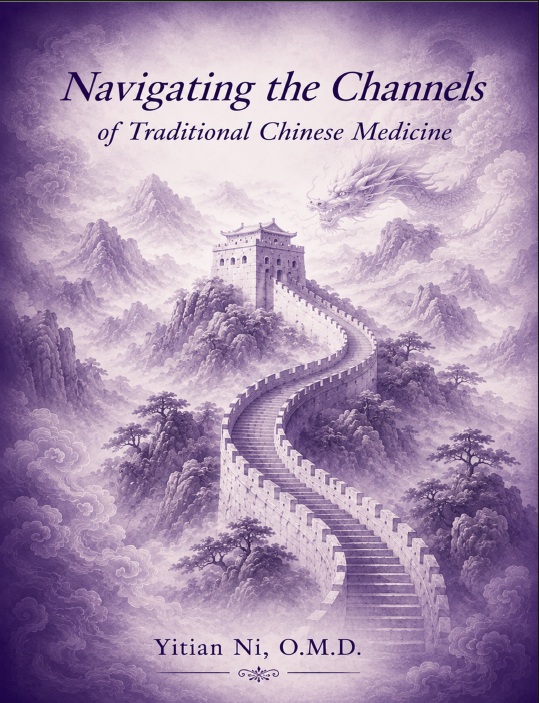
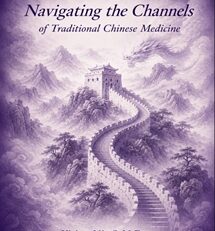
Navigating the Channels offers a clear, clinically grounded guide to channel theory and the interconnected systems of channels and collaterals. Drawing on decades of experience teaching and practicing Chinese medicine in both China and the United States, Yitian Ni presents the channel system as a practical framework for understanding physiology, pathology, diagnosis, and treatment.
The book examines the twelve primary channels and extraordinary vessels, including their pathways, associated organs and points, key characteristics, physiological functions, pathological patterns, and clinical applications. It also explores the divergent, sinew, and collateral channels, helping readers understand how these systems relate to one another and inform clinical practice.
Twenty illustrative case histories, including treatment strategies, demonstrate how channel theory can be applied in actual clinical situations. A concise glossary and bibliography complete this accessible resource for students and practitioners seeking a deeper, more integrated understanding of the channel system.
About the Author
Yitian Ni began teaching and practicing traditional Chinese medicine in the late 1960s, continuing a medical tradition passed down through generations of her family. She graduated from—and later taught for many years at—the Nanjing College of Traditional Chinese Medicine. Her education encompassed both Chinese and Western medicine and supported her participation in scientific research, as well as the publication of several books and numerous scholarly papers.
Her teaching career included appointments at the Nanjing College of Traditional Chinese Medicine; the International Training Center of Acupuncture and Herbs, jointly sponsored by the World Health Organization and the Ministry of Health of the People’s Republic of China; the Academy of Traditional Chinese Medicine in Beijing; the American Institute of Oriental Medicine; and Pacific College of Oriental Medicine in San Diego, California.
Angel Lyn Horner –
Book Review:
Navigating the Channels of Traditional Chinese Medicine. By Yitan Ni, O.M.D.
Written by: Angel Lyn Horner, AP, DACM
The Jing Lou channel system acts as invisible pathways to transport Qi (Vital Energy), blood, and nourishment through the channels and collaterals. Sending this nourishment to every part and organ of the human body. These Channels link the internal organ system, or Zang Fu, creating a web that unifies a person’s physical and emotional health. This helps the body to maintain normal and optimal function and health.
In the book “Navigating the Channels of Traditional Chinese Medicine,” Yitan Ni quotes a Ming Dynasty physician, Li Yan: “The practice of acupuncture without knowing the channels is like working at night without a candle or sailing without navigation.” A firm base of understanding the channel and Collateral system is a must, especially for students learning Acupuncture and Traditional Chinese Medicine. Channel and Collateral theory provides a sound basis for theoretical diagnosis and does not leave one relying solely on Zang Fu theory.
Yitan Ni has practiced and taught TCM since the late 1960’s in the PRC and USA. She carries a handed-down teaching- a direct lineage from generations in her family. She is educated in Western and TCM, and has participated in scientific research. In her book Navigating the Channels, she goes into detail on the functions, components, and characteristics of the channel system: the twelve cutaneous channels, the luo system with its major collaterals. She discusses the importance and clinical application of each. She also discusses how the channel system has an interwoven relationship with the organs and other body structures and sensory organs.
It is wonderful how she takes each channel, summarizes related pathologies for each, and the clinical application with key and combination points from other channels. Each channel is broken down in detail, with pathway diagrams of each at the end of the chapters. Her excellent descriptions of the physiology of each include symptoms to identify for each one.
Case studies at the end of the book are written clearly and concisely; they are easily accessible and highly digestible for new students. The book is to be commended for including details often overlooked, such as divergent, tendomuscular, and collateral channels. An in-depth glossary gives definitions for many Chinese Medical terms and how they fit into the mainstream medical box.
Yitan Ni, for example, goes into detail about terms relating to the channels and collaterals, such as how the Lung tendomuscular “knots” (Jie) in certain areas, where the qi and blood of each tendomuscular channel concentrate in certain areas, generally at large muscles or joints. Where there is “Ju,” or the convergence of two or more, and the musculoskeletal area binds together. “San”- dispersion, where the qi disperses in large muscle groups, and the “Lou”- or connecting of the muscles, tendons, ligaments, and joints. The “Jie,” or “Knot” areas spoken of throughout the book, are considered concentration areas of special importance.
Navigating the Channels of Traditional Chinese Medicine by Yitan Ni should be considered a very valuable and indispensable source for students and practitioners looking for information that bridges the gap between dense Classical theory and modern clinical practice. A definite thumbs up!